
Hey folks—Marcus Hale here. I’ve spent years listening to people who are doing their best to stay steady in a loud world: parents running on fumes, caregivers carrying too much, professionals whose nervous systems never really clock out. When stress becomes your default setting, “just relax” isn’t advice—it’s a dare.
This guide breaks down how the
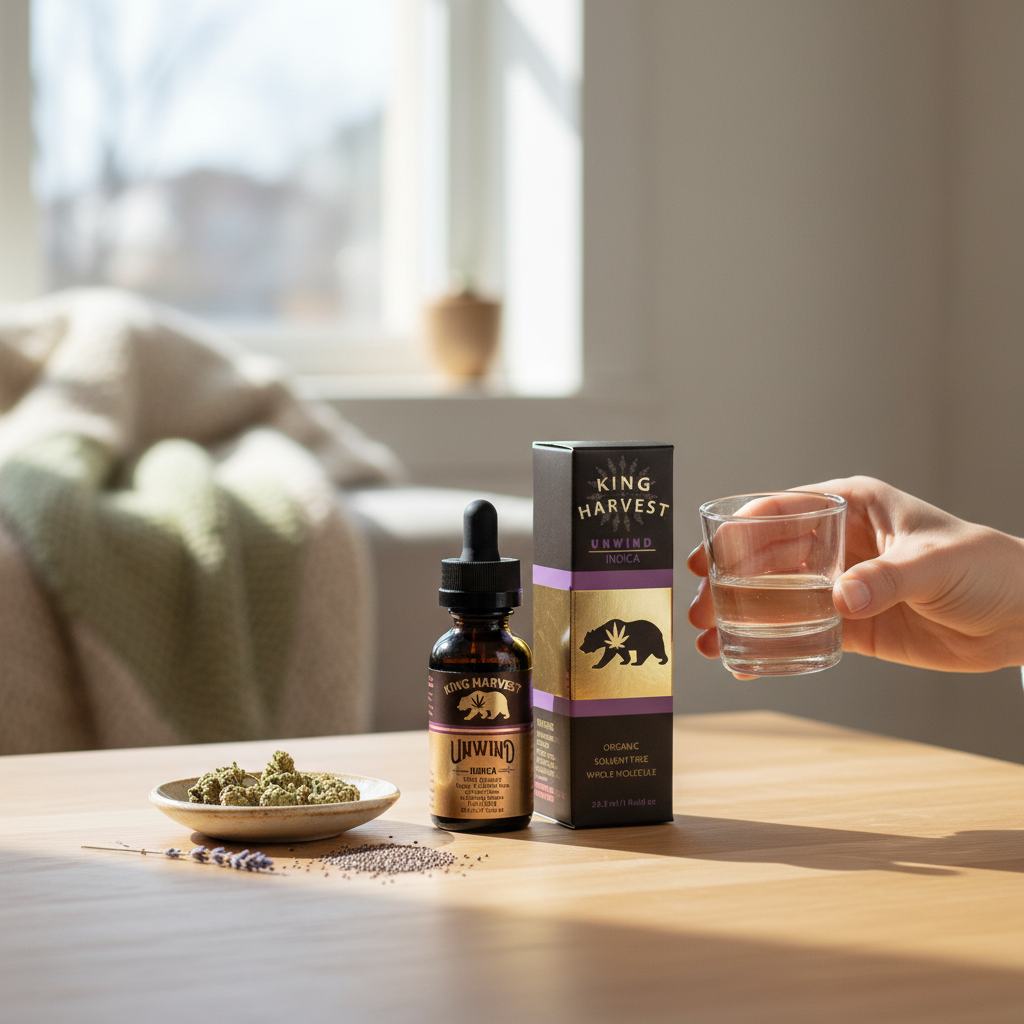
Unwind – Indica THC Tincture
from King Harvest Wellness can fit into a practical, organic stress-relief protocol—without hype, without miracle language, and with the kind of pacing that respects your body.
I’m not a clinician, and this isn’t medical advice. If you take prescription meds, have a diagnosed condition, are pregnant, or you’re unsure about interactions, talk with a qualified professional first.
What Is Unwind Indica THC Tincture?
The
Unwind – Indica THC Tincture
is a sublingual tincture made by King Harvest Wellness using organic cannabis inputs and third-party lab testing. Practically speaking, it’s designed for people who want:
measured dosing, smoke-free use, and a steady, predictable routine.
Tinctures are popular because they sit in a sweet spot: faster onset than edibles, easier dose control than flower, and more discreet than many inhalation options.
If you’re comparing formats, King Harvest also offers a faster-onset alternative via inhalation:
Unwind – Indica THC Vape Cartridge.
If you’re new to King Harvest standards, I recommend reading their explainer on why lab testing matters:
What makes a product “lab-tested” and why does it matter?
Why Indica-Style THC Protocols Can Feel Different for Stress
People use “Indica” as shorthand for a more settling experience—less “let’s reorganize the garage at 10 p.m.” and more “exhale, unclench, and come back to baseline.”
Individual response varies, but the goal in a stress protocol is usually one of these outcomes:
- Downshift the nervous system after work or caregiving
- Reduce rumination (the mental loop that won’t stop)
- Support sleep readiness without feeling knocked out
Stress is also widespread. The American Psychological Association has repeatedly documented high stress levels among U.S. adults and the downstream health impacts of chronic stress
(APA Stress in America resources).
That doesn’t mean THC is “the answer.” It does explain why so many people are exploring plant-based wellness routines alongside basics like sleep hygiene, movement, and mindful decompression.
A grounded research note (not a promise)
In one of the most-cited real-world datasets, researchers using a mobile app found that participants reported symptom relief (including stress-related complaints) shortly after cannabis use
(Cuttler et al., 2018).
Self-reported data has limitations, but it’s useful because it reflects how people actually use cannabis in day-to-day life.
Organic Stress-Relief Protocols: How to Use Unwind (Step-by-Step)
Let’s keep this practical. A “protocol” isn’t a rigid rule—it’s a repeatable routine you can adjust with intention. The two big mistakes I see are:
taking too much too soon and re-dosing before the first dose has fully landed.
Protocol 1: Microdose to take the edge off (beginner-friendly)
- Pick a low-stakes day. Don’t experiment for the first time before a big meeting or family event.
- Start low. If you know your mg-per-drop, aim for a microdose (often in the 1–2.5 mg THC range). If you don’t, use the smallest measurable amount.
- Sublingual method: place under the tongue, hold 30–60 seconds, then swallow.
- Wait long enough: give it 60–120 minutes before deciding whether to increase (sublingual can be quicker, but bodies vary).
- Increase slowly: adjust in small steps across different days—not the same hour.
If you want more on the “small dose, big control” mindset, you’ll like this related read:
King Harvest dosing articles.
Protocol 2: Evening unwind routine (for end-of-day decompression)
This is the routine I hear most often from people who feel “wired but tired”:
- 60–90 minutes before bed: small dose of Unwind tincture
- 10 minutes of downshift: shower, stretching, or breathwork
- Screen dimming: lower brightness, reduce notifications
- Journal prompt: “What can wait until tomorrow?”
If you want a more balanced cannabinoid profile for nighttime, consider:
Synergy PM – CBD/THC Tincture
(a 1:1 style option many people prefer when THC alone feels too sharp).
There’s also the product hub here:
Synergy PM collection.
Protocol 3: Daytime balance (when you still need to function)
If your goal is “calm, not couch,” a 1:1 tincture is often the better starting point than a THC-forward tincture. That’s where
Synergy – CBD/THC Tincture
or a CBD-only option like
Restore – CBD Tincture
can make more sense.
Stats You Can Use (Without Overclaiming)
-
Stress is common: The APA documents widespread stress and associated health impacts across U.S. adults
(APA). -
Real-world symptom tracking: In app-based, observational research, participants commonly reported symptom reductions after cannabis use
(Cuttler et al., 2018). -
Dependence risk exists (and it’s worth respecting): NIDA summarizes cannabis use disorder and notes that some users develop problematic use patterns
(National Institute on Drug Abuse).
Case Study: A Simple 14-Day “Unwind Window” Protocol (Realistic and Repeatable)
Here’s a case I can share because it’s common, de-identified, and measured in a way that’s actually useful.
A King Harvest community member (late 30s, remote work, high stress, trouble “shutting off” at night) tried a 14-day protocol built around a consistent evening routine.
They weren’t chasing a strong high—they wanted a reliable off-ramp.
Starting point
- Baseline: “Stress feels stuck in my body,” nightly rumination, difficulty falling asleep
- Tools: Unwind tincture + 10 minutes stretching + journaling
- Tracking: 1–10 self-rating for evening stress + minutes-to-sleep estimate
What changed by day 14
- Evening stress score: average dropped from 7/10 to 4/10
- Time-to-sleep: improved from ~60 minutes to ~30 minutes on most nights
- Next-day feel: fewer “stress hangover” mornings when dose stayed low and consistent
Important caveat: this is not a clinical study, and results vary. But as a real-life template, it shows what works best in practice:
small dose + consistent timing + one supportive habit.

If you’d like help building a plan around your schedule and sensitivity, start here:
Free Consultations for Medical Cannabis | King Harvest.
Expert Quote: Whole-Plant Context and the Entourage Conversation
I’m careful with “expert quotes” because credentials don’t replace your lived experience—but they can add context.
Neurologist and cannabis researcher Dr. Ethan Russo has discussed how cannabinoids and terpenes may work together in ways that differ from isolated compounds, a concept often referred to as the entourage effect
(Russo, 2011 (NIH/PMC)).
Translation in plain English: some people report a more rounded experience with whole-plant style formulations than with single-compound products.
That’s not a guarantee—and it’s not a medical claim—but it’s a helpful framework when you’re choosing between options.
Safety, Considerations, and “Don’t Learn This the Hard Way” Tips
- Start low, go slow. Especially if you’re THC-sensitive or returning after a long break.
- Don’t mix with alcohol or sedatives. Stacking depressants can increase impairment.
- Avoid driving. If you feel altered, you’re not cleared to operate a vehicle.
- Plan your setting. First-time use should happen at home with no obligations.
- Choose lab-tested products. Here’s King Harvest’s lab-testing FAQ:
read it here. - Pets: Use pet-specific products only and consult a veterinarian. For pet wellness support, see
Synergy PM Pet Tincture.
Related King Harvest Options (So You Can Build a Complete Routine)
-
Evening balance:
Synergy PM – CBD/THC Tincture -
Daytime balance:
Synergy – CBD/THC Tincture -
Non-psychoactive routine support:
Restore – CBD Tincture -
Browse all tinctures:
Tinctures from King Harvest – 100% organic -
Prefer edibles for nighttime?
Unwind – Indica Infused Chocolate Bar
FAQ: Unwind Indica THC Tincture for Stress
How do I dose Unwind Indica THC Tincture for stress?
Start with the smallest measurable amount and wait 60–120 minutes before adjusting. Track dose, timing, and your stress level for a few days before increasing. If you want help personalizing a protocol, use King Harvest’s free consultation option.
How long does a sublingual THC tincture take to kick in?
Many people feel effects within 15–45 minutes, but it can take longer depending on dose, metabolism, and whether some is swallowed. When in doubt, wait longer before re-dosing.
Is Unwind safe for daily use?
Many adults use THC tinctures routinely, but daily use isn’t right for everyone. Use the lowest effective dose, take breaks if you notice tolerance, and avoid combining with alcohol or sedatives. If you have health conditions or take medications, consult a qualified professional first.
Can I combine Unwind with other King Harvest products?
Yes. Many people pair THC-forward products with balanced or CBD-forward options depending on the time of day. Common pairings include Synergy (1:1) for daytime balance and Restore (CBD) for non-psychoactive support.
What should I use for pet stress—can pets take Unwind?
Use pet-specific formulations and consult a veterinarian. For King Harvest’s pet line, consider Synergy PM Pet Tincture rather than human tinctures.
Conclusion: A Calm You Can Repeat
If stress has been running your schedule, the goal isn’t to “knock yourself out.” It’s to build a calm you can repeat—dose, timing, and habits that your body trusts.
If you’re ready to explore, you can find details on the product page here:
Unwind – Indica THC Tincture.
And if you want a human being to help you think it through, start with
a free consultation.
About the Author
Marcus Hale is a natural wellness writer focused on organic cannabis routines, patient-first education, and practical harm-reduction. He’s spent years interviewing patients, caregivers, and formulators to translate cannabis into plain-English protocols you can actually use. Off the clock, he’s usually hiking ridgelines or unwinding with tea and a notebook.
